Axis Adds a Group C for Points Transfers, Alongside Group A and Group B
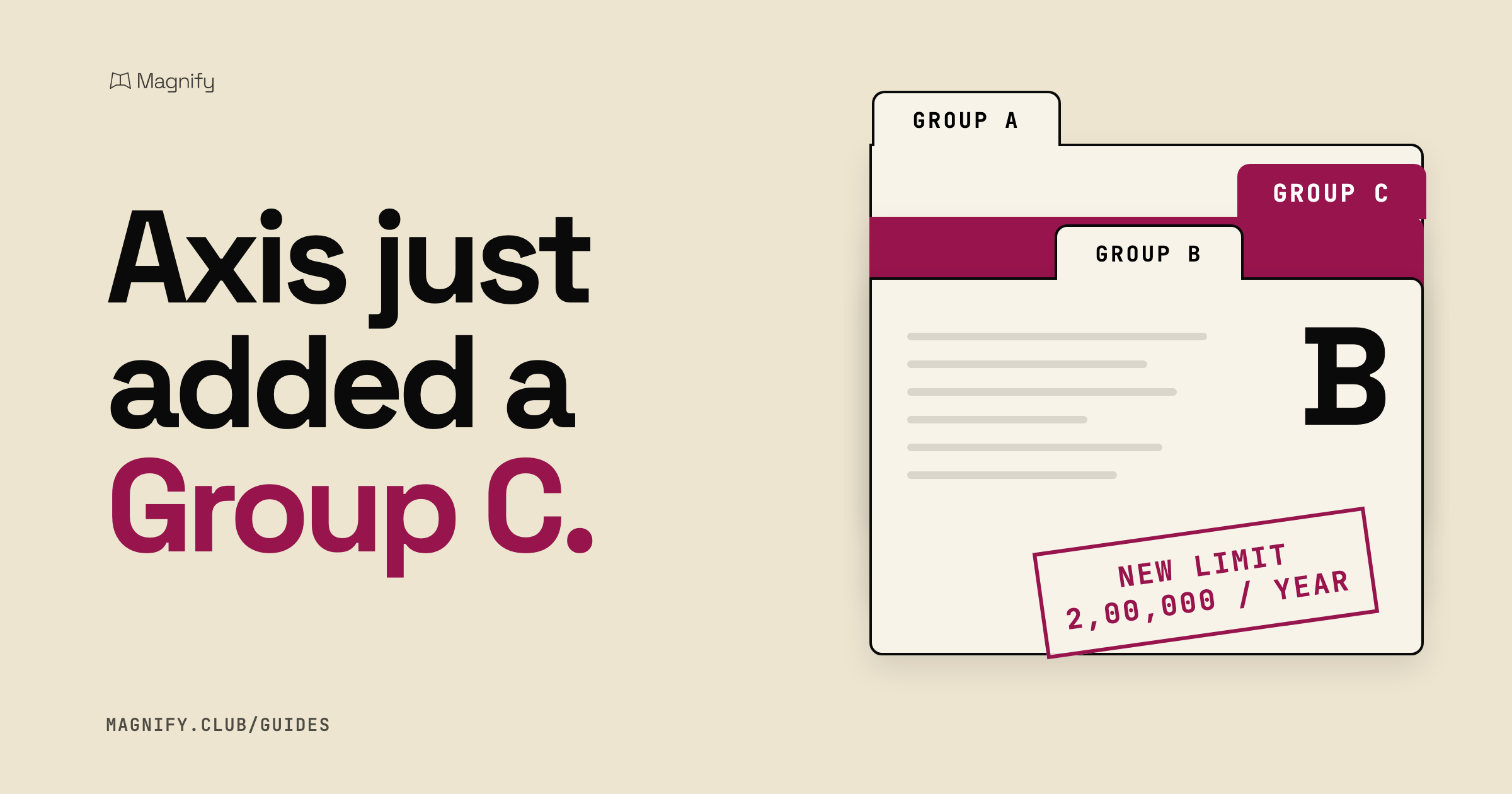
Axis now has a third transfer limit next to Group A and Group B: a 2,00,000 mile yearly cap on one partner. It lands on Olympus and Burgundy cardholders.
In September 2026, Axis Bank rewrote its transfer partner list, and one of the additions was Lufthansa Miles & More. Look at the partner list on the Travel EDGE terms page and it seems like good news. Miles & More sits in Group B, the bucket with the big yearly limits, at the standard ratio on most cards (1:4 on Olympus, 5:4 on Burgundy Private). If you hold an Olympus, the group table tells you that you can send up to 6,00,000 EDGE Miles a year to Group B partners, and Miles & More is one of them.
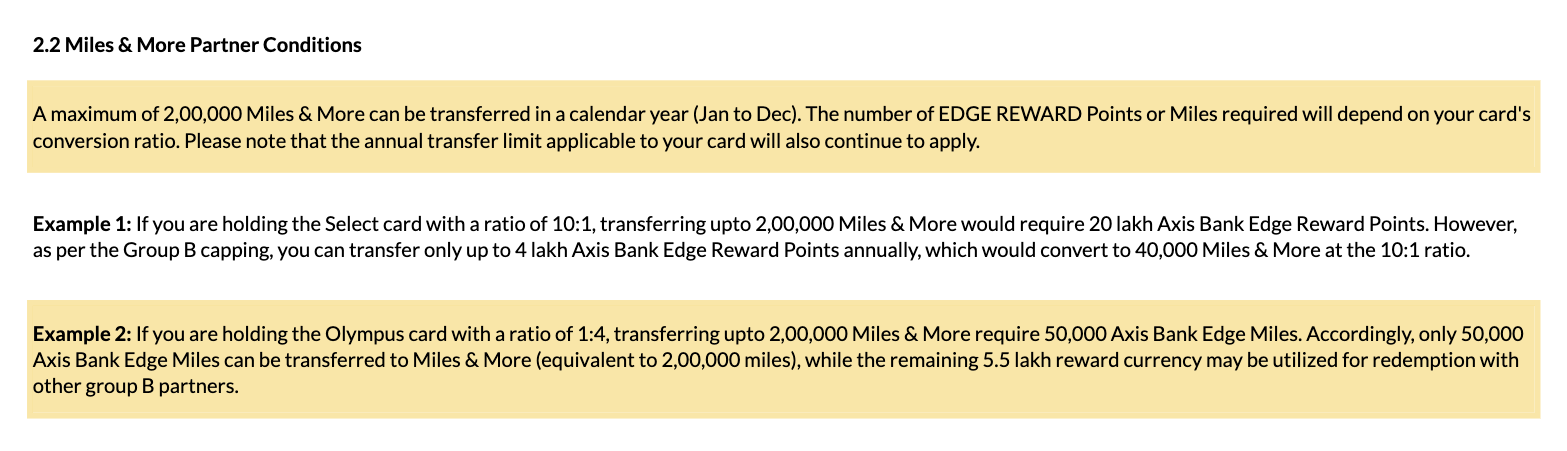
Except you can't. A small clause came along with the new partner, "2.2 Miles & More Partner Conditions", and it says you can transfer at most 2,00,000 Miles & More miles in a calendar year, whatever your Group B limit says. For an Olympus, that's 50,000 EDGE Miles, not 6,00,000. None of this shows up in the group table. Miles & More is listed there as an ordinary Group B partner, with nothing next to its name. If I hadn't read the fine print, I'd never have known that Group B now has a second limit inside it.
Axis already has a system for exactly this. Partners sit in Group A or Group B, each group has its own yearly cap, and there's a table showing who's where. A partner with its own separate ceiling is a new group in everything but name. So if Axis wants to cap a partner on its own, it should add a Group C to that table and put the limit where people look. Instead it's a footnote, and I think that's the worst part of the whole September update, worse than Accor coming back at half the ratio.
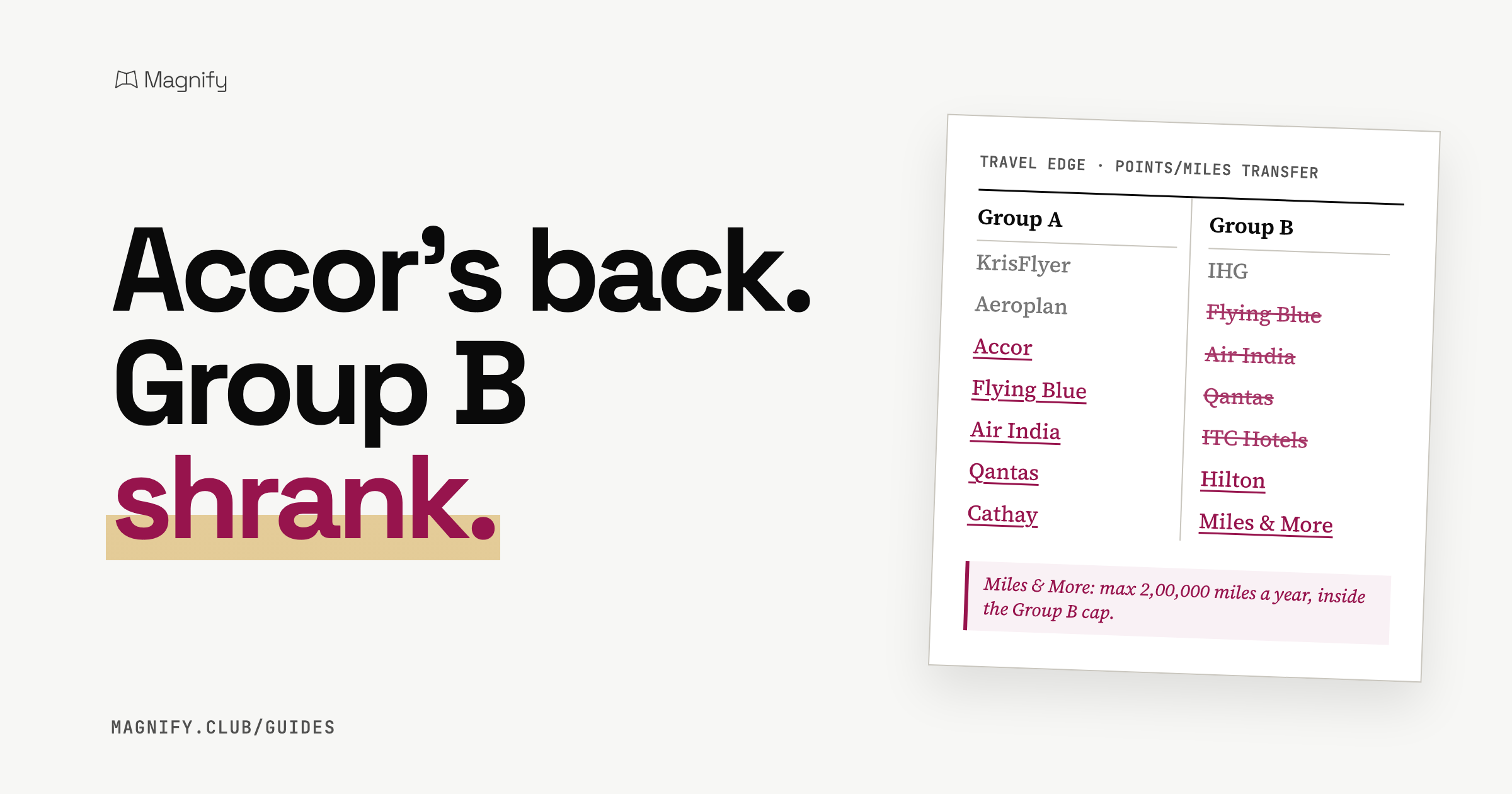
The rest of the September changes (Accor's return, Flying Blue and Air India moving to Group A, the other new partners) are covered in the post linked above. This one is only about the Miles & More limit.
How the Miles & More Limit Works
Every Axis card already has a yearly Group B limit, counted in EDGE Reward Points or EDGE Miles. We explain how the Group A and Group B caps work in a separate guide. Miles & More now has a second limit of its own, counted in Miles & More miles: 2,00,000 a year, with a minimum of 3,000 miles per transfer.
Because one limit is counted in Axis points and the other in partner miles, whether the new one matters depends on your card's ratio. The test is simple. Take your Group B limit, convert all of it to Miles & More at your card's ratio, and see if it comes to more than 2,00,000 miles. If it doesn't, your Group B limit runs out first and the new cap can never bite. If it does, the cap cuts in before your Group B limit does.
The Cards It Hits, and the Ones It Doesn't
| Card | Group B limit | Ratio | Group B limit in Miles & More miles | Share of Group B you can send to Miles & More |
|---|---|---|---|---|
| Olympus | 6,00,000 EDGE Miles | 1:4 | 24,00,000 | 8% |
| Burgundy Private | 12,00,000 points | 5:4 | 9,60,000 | 21% |
| Magnus for Burgundy | 8,00,000 points | 5:4 | 6,40,000 | 31% |
| Horizon | 4,00,000 EDGE Miles | 1:1 | 4,00,000 | 50% |
| IndianOil Axis Premium | 4,00,000 points | 2:1 | 2,00,000 | 100% |
| Magnus, Reserve | 4,00,000 points | 5:2 | 1,60,000 | 100% |
| Atlas | 1,20,000 EDGE Miles | 1:1 | 1,20,000 | 100% |
| Select, Privilege, Rewards | 4,00,000 points | 10:1 | 40,000 | 100% |
Take Olympus. Its Group B limit is 6,00,000 EDGE Miles, which at 1:4 would be 24,00,000 Miles & More miles. The 2,00,000 mile cap is reached after just 50,000 EDGE Miles, so the other 5,50,000 has to go to Hilton, IHG or another Group B partner. Axis uses this exact example in its own terms. On Burgundy Private, 2,00,000 miles at 5:4 takes 2,50,000 points, out of a 12,00,000 point Group B limit.
Now Magnus. Its whole 4,00,000 point Group B limit, converted at 5:2, comes to 1,60,000 Miles & More miles. That's under 2,00,000, so a Magnus holder physically can't reach the new cap, and nothing changed for them. The same goes for Reserve, Atlas and the Select, Privilege and Rewards cards. On IndianOil Axis Premium, the two limits land at exactly 2,00,000 miles, so again nothing changes.
So if you hold one of the cards at the bottom of the table, you can stop reading here. If you hold one of the top four, keep going.
Why This Is Worse Than It Looks
You'd only know if you read the fine print
The whole point of Axis's group system is that you can check one table and know how much you can send where. The Miles & More clause breaks that. The parts people look at, the partner list and the group table, tell an Olympus holder that 6,00,000 EDGE Miles can go to Miles & More. Only clause 2.2 says 50,000.
If this had been introduced as Group C, Axis would have had to put it in the table: which partners are in it, what the cap is, and how it sits alongside the other two. Keeping Miles & More inside Group B lets the bank show it next to Group B's generous limits while applying a much smaller one. The new partner got a line in the partner list and a place in the group table. The limit that came with it deserved the same.
It lands on the people paying the most
Look at who's in the top half of that table. Three of the four cards the limit restricts are Olympus, Burgundy Private and Magnus for Burgundy, Axis's most premium cards. They got the best Miles & More ratios, and those good ratios are exactly why they run into the limit. Magnus, Reserve, Select and the rest slip under it. Whatever Axis intended, the effect is a cap that mostly lands on its best customers.
The generous ratio is mostly for show
Olympus converts to Miles & More at 1:4, which looks excellent on the partner list. But that ratio only applies to 8% of the card's Group B limit. Past 50,000 EDGE Miles, the 1:4 ratio stops mattering, because you can't use it anymore. Axis gets to advertise a strong ratio while making sure very few points ever move at it.
We've watched Axis make partners cheaper for itself by cutting ratios. Qatar in July and Accor in September both came back on a reduced ratio tier. Capping volume is the second way to do the same thing, and it's less visible, because the ratio on the partner list still looks good.
It's a template for every other partner
Until September, the two group limits were the only ceilings in the Axis program. Partner-level limits didn't exist. Now there's one in the terms, with worked examples and a clause number, and the same terms say the Group A and Group B classification and partner list can change at the bank's discretion without notice. Nothing stops Axis adding a Hilton limit or an IHG limit in the next rewrite. Once a bank has built a mechanism, it tends to use it again.
Group B is shrinking from both ends
Group B used to be where you sent big balances once your Group A limit ran out. In the same update, Axis moved Flying Blue, Air India and Qantas out of it and into Group A. The one big new international airline program that joined Group B, Miles & More, arrived with its own cap. What's left uncapped in Group B is AirAsia, Hilton, IHG, IndiGo BluChip, Orchid, The Postcard Sunshine Club, Radisson and SpiceJet. That's mostly hotels and domestic airlines. For premium cardholders, a large Group B limit is worth less every time an airline leaves it.
Is 2,00,000 Miles & More a Year Actually a Problem?
To be fair to Axis, 2,00,000 miles is a lot of Miles & More for one person in one year. A Business Class round trip to Japan costs 75,000 miles, so the cap still covers more than two of those. If you fly once a year as a couple, you probably won't notice it.
Where it bites is a family of four booking premium cabins, or a Burgundy household that was using Miles & More as its main Star Alliance currency now that Flying Blue and Air India have moved into the tighter Group A. But the bigger problem isn't this year's number. It's that Axis now caps partners individually, and the number can be lowered, or copied onto other partners, as easily as it was introduced.
What to Do If You Hold One of the Affected Cards
Plan Miles & More transfers by calendar year. The limit resets on January 1, same as the group limits. If you need more than 2,00,000 miles for a trip in early 2027, split the transfer across December and January.
Don't transfer ahead just to use the allowance. Miles & More expires miles in batches, and it's stricter than most programs about it. Moving 2,00,000 miles in December because you can is how points end up expiring. We wrote about why speculative Axis transfers backfire, and it applies doubly here.
Use the co-brand card if you need more. Miles earned on the Miles & More Axis Bank credit cards are earned directly, not transferred, so they don't count against any transfer limit. The earn rate is slow, but the miles don't expire while the card is active. The Miles & More guide compares both versions of the card.
Look at other Star Alliance programs. If you want Star Alliance and the Axis caps keep closing in, Air India's Maharaja Club is also Star Alliance. You can earn Maharaja Club points through Mag Miles on the Magnify app from your everyday spending, and those transfers aren't counted against any bank's limit. The Magnify app also shows every card you hold that transfers to each program, with the current ratio.
Frequently Asked Questions
Has Axis Bank created a Group C?
Not officially. Axis's terms still only have Group A and Group B. But since September 2026, Lufthansa Miles & More has its own limit of 2,00,000 miles a year inside Group B, which works like a third group for the cards it affects. "Group C" is our name for it, not Axis's.
What is the Axis Bank limit on Miles & More transfers?
You can transfer at most 2,00,000 Miles & More miles per calendar year (January to December), and your card's normal Group B limit still applies as well. The minimum transfer is 3,000 Miles & More miles.
Which Axis cards are affected by the Miles & More limit?
Olympus, Burgundy Private, Magnus for Burgundy and Horizon. On these cards, the limit cuts in before the Group B limit does, so only 8% to 50% of your Group B allowance can go to Miles & More. Magnus, Reserve, Atlas, Select, Privilege, Rewards and IndianOil Axis Premium are not affected, because their Group B limit runs out at or below 2,00,000 Miles & More miles anyway.
How many EDGE Miles can an Olympus holder send to Miles & More?
50,000 EDGE Miles a year. At the Olympus ratio of 1:4, that's 2,00,000 Miles & More miles, which is the cap. The remaining 5,50,000 EDGE Miles of the Olympus Group B limit can only go to other Group B partners.