OneCard Credit Card Review: The Lifetime-Free Metal Card With a Quiet Rewards Story
OneCard is India's best-known lifetime-free metal credit card. 1% forex, never-expiring points, and a slick app. The rewards rate is also much smaller than aggregators claim. Here's the honest breakdown.
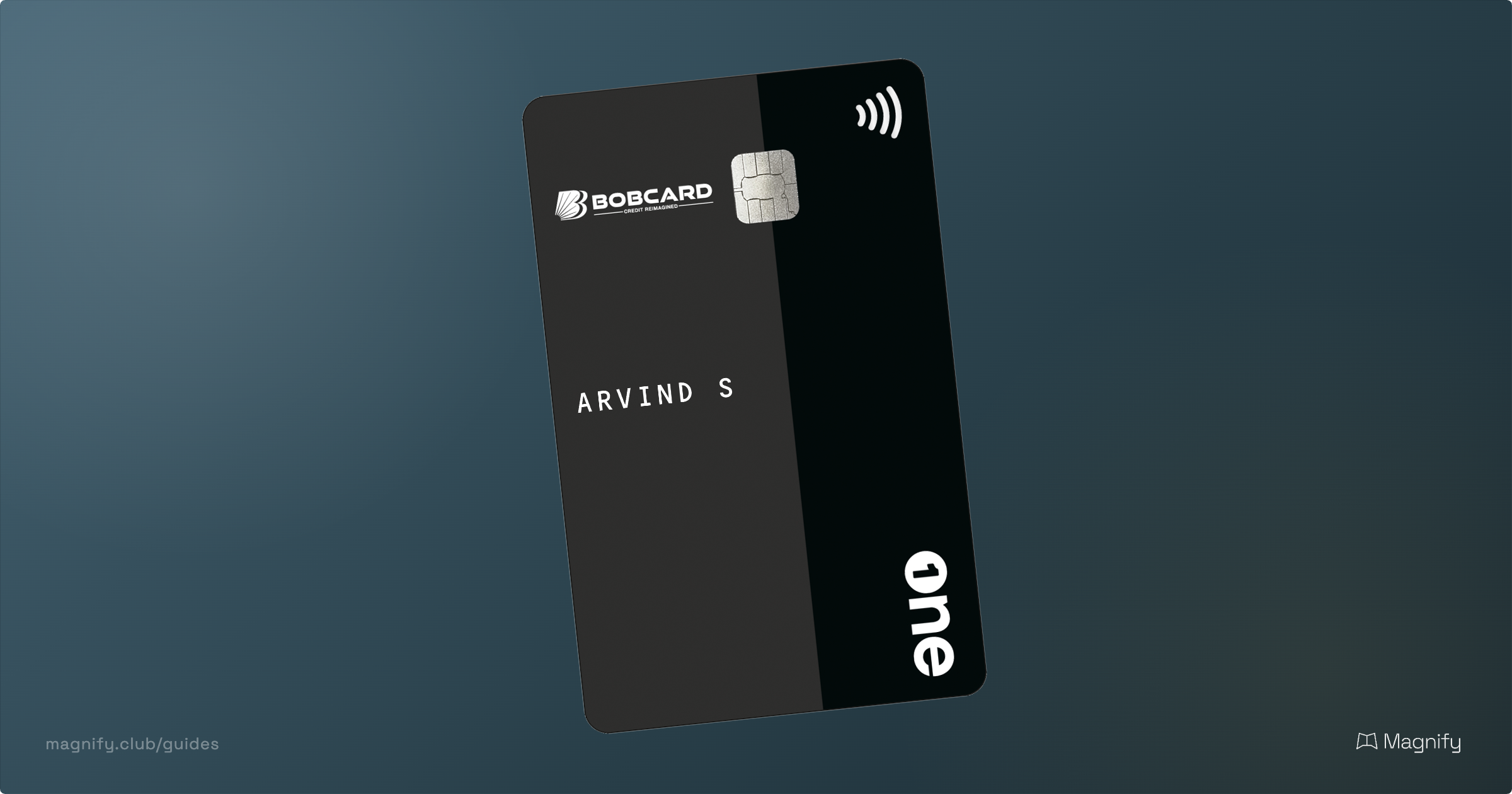
OneCard has become the default answer when someone in India asks for a lifetime-free metal credit card. It is also one of the most over-explained and slightly mis-explained cards in the market. The 5X rewards story is real on paper, but the way it actually works out in rupees is much more modest than most reviewers let on. The truly distinctive parts of the card, the 1 percent foreign currency markup and the fact that you genuinely pay nothing to hold it, do not get nearly enough airtime.
This is the honest review.
OneCard is operated by FPL Technologies and issued in partnership with seven Indian banks: BOBCARD (Bank of Baroda), CSB Bank, Federal Bank, IDFC FIRST Bank, SBM Bank India, South Indian Bank, and Indian Bank. The product features and rewards mechanics are identical across issuers. Only the bank name on your statement and the grievance escalation path change.
At a Glance
| What you get | What it actually means |
|---|---|
| Joining fee | ₹0 (Nil) |
| Annual fee | ₹0 (Nil), lifetime |
| Card material | 16-gram metal card with name engraved |
| Virtual card on approval | ✓ Instant via the OneCard app |
| Base reward rate | 1 RP per ₹50 (about 0.2% in cashback value) |
| 5X categories | 5 RP per ₹50 (about 1.0% in cashback value) |
| Foreign currency markup | 1.0% plus GST (very low for India) |
| Fuel surcharge waiver | 1% waived, capped at ₹400 per month |
| Reward expiry | None, unless the card is inactive over 365 days |
| Lounge access | ✗ Not offered |
| Airline or hotel transfer partners | ✗ Not offered (closed-loop rewards) |
| Add-on plastic card fee | ₹0 |
| Add-on metal card fee | ₹3,000 |
Get it if: you want a no-cost premium-feeling card mainly for foreign currency spends and as a daily-driver where the app controls actually save you trouble.
Skip it if: you are chasing high cashback rates, you need lounge access, or you want transferable miles. Dedicated cashback cards and travel cards will out-earn OneCard on those use cases.
One Card, Seven Issuers
OneCard is not technically a single card. It is a single product issued by seven different Indian banks. When you apply through the OneCard app, the app routes your application to one of these partner banks based on internal underwriting logic. You do not choose your issuer, and the issuer does not change the card experience in any meaningful way.
The seven issuers as of 2026 are BOBCARD, CSB Bank, Federal Bank, IDFC FIRST Bank, SBM Bank India, South Indian Bank, and Indian Bank. We pulled the schedule of charges from each issuer's Key Fact Statement, and the numbers match across all of them: same 45 percent annual interest rate, same 48-day grace period, same 1 percent forex, same fuel waiver, same late payment slabs.
The two minor places where issuers differ are the cash advance facility (CSB charges 2.5 percent for cash withdrawal, Federal Bank does not offer the facility at all, and the others are silent), and the staggered rollout of an upcoming 1 to 2 percent surcharge on rent and wallet spends, which different banks have scheduled across late 2025 and 2026.
For the cardholder, OneCard is OneCard. The product page, the app, the rewards engine, and the customer experience are operated by FPL Technologies regardless of which bank shows up on your monthly statement.
The 5X Rewards Story, Properly Explained
OneCard's marketing leads with 5X reward points on your top 2 spending categories. This is true. It is also explained in a way that makes the card sound a lot more rewarding than it is.
The base earning rate is 1 OneCard Reward Point for every ₹50 spent. This is documented identically in all seven issuer Terms and Conditions. A ₹100 grocery bill earns 2 Reward Points. A ₹2,500 hotel booking earns 50 points. There is no minimum transaction size, and fractional points are credited, so a ₹25 spend earns half a point.
The 5X feature is a multiplier on this base rate. If groceries and dining end up as your two highest-spend categories in a calendar month, those categories earn 5 times the base rate, which works out to 5 Reward Points per ₹50, or 10 points per ₹100.
There are two important qualifications most reviewers do not mention. First, to qualify for the 5X bonus at all in a given month, you have to spend across at least 3 categories and put a minimum of ₹750 into each of those 3 categories. Concentrating your spend in 1 or 2 categories disqualifies the bonus entirely. Second, for the specific categories of Education, Bill Payments, and Insurance, the 5X bonus is capped at 25,000 Reward Points per month.
Categories are defined internally by FPL Technologies. They are not user-selectable, and OneCard does not publish a list of which merchants or MCC codes map to which category. You can only see your top 2 in retrospect, after the cycle closes.
The base points credit to your account instantly. The 5X bonus credits on the 10th of the following month.
The Quiet Bit: How Much Each Reward Point Is Actually Worth
This is where OneCard gets unusual. Most credit card sites in India quote OneCard at 1 Reward Point equals ₹1, which would make the 5X bonus worth roughly 10 percent in effective cashback. That number is not supported by any official OneCard document.
OneCard's own blog posts state that Reward Points redeem at 10 percent value, which is 1 RP equals ₹0.10. The clearest example is in their guide on using OneCard for hotel bookings, which says: "if you have 2,000 reward points, you can get ₹200 as cashback." The same 10 percent value is referenced in their utility bills blog.
At 10 percent value, the actual cashback math looks like this:
| Spend type | Points earned | Cashback value | Effective rate |
|---|---|---|---|
| Base rate (most spends) | 2 RP per ₹100 | ₹0.20 per ₹100 | 0.2% |
| Top 2 categories (5X) | 10 RP per ₹100 | ₹1.00 per ₹100 | 1.0% |
A 1 percent effective return on your two biggest spending categories is decent for a lifetime-free card, but it is not the 10 percent number that gets thrown around. And to even unlock that 1 percent, you have to spread your spending across 3 categories with at least ₹750 in each, every month.
How You Actually Redeem
OneCard redemption is one of the cleanest in the Indian market. You open the OneCard app, find a transaction from the last 2 months in your statement, and apply your accumulated points against it at the 10 percent rate. There is no minimum redemption amount, no annual cap, and no redemption fee. You do not have to convert points to vouchers or claim a benefit. The cashback shows up against your actual statement.
| Channel | How it works |
|---|---|
| Pay with Points | Use points against any past transaction less than 2 months old. Currently 1 RP = ₹0.10. |
| Cashback or statement credit | Redeem points directly as cashback at the same 10 percent value. |
| In-app offers | Rotating offers and brand vouchers inside the OneCard app, with conversion rates that can vary by offer. |
The 2-month redemption window matters. You cannot bank up points all year and dump them against a fresh transaction in December. If you spend ₹50,000 in January and do not apply your January points against any of those January transactions before March, those specific transactions are no longer eligible for Pay with Points. Your points balance is fine, but the window for using them against those specific transactions has closed. The fix is simple: redeem fortnightly or monthly inside the app, do not let points pile up.
OneCard Reward Points are also not transferable to any airline or hotel program. This is a closed-loop currency. If transferable miles are what you want, OneCard is not the card for that role.
The Actual Killer Feature: 1 Percent Forex
OneCard's foreign currency markup is 1.0 percent. With 18 percent GST, the effective forex cost is about 1.18 percent. That is the lowest forex markup of any genuine lifetime-free Indian credit card. Most lifetime-free cards charge 3.5 percent. Most premium metal cards with a 1 percent or sub-1 percent forex rate, like HSBC Premier or some Amex variants, come with annual fees in the tens of thousands.
Concretely, if you spend ₹2,00,000 on foreign currency transactions in a year (one big international trip, plus year-round foreign-currency subscriptions and online shopping), the difference between a 3.5 percent card and OneCard's 1 percent works out to roughly ₹5,000 in saved markup. That is more than most cashback cards return on the same spend.
International transactions also earn the base reward rate of 1 point per ₹50, so you are not giving up rewards on foreign spends.
If we had to pick one reason to keep OneCard in the wallet, the forex rate is it. The 5X cashback is a small bonus. The lifetime-free metal is a perk. The 1 percent forex is a portfolio-level edge.
For a side-by-side feel of where 1 percent forex sits versus the rest of the market, our HSBC TravelOne review covers a 0.99 percent forex card with airline transfer partners, which sits at a higher fee tier. The comparison shows when paying for forex with an annual fee makes sense and when OneCard's zero-fee 1 percent is the cleaner answer.
What Does Not Earn Points
OneCard has a focused list of excluded categories that do not earn any reward points, and in some cases attract additional surcharges. These are common to all seven issuers.
| Category | Earns RP | Notes |
|---|---|---|
| Fuel | ✗ | No RP, but the 1% fuel surcharge waiver applies (capped at ₹400 per month) |
| Rent payments | ✗ | No RP, plus a 1% (rising to 2%) surcharge on the transaction |
| Wallet load and P2P transfers | ✗ | No RP. Above ₹10,000 per month, also a 1% to 2% surcharge |
| Cash advance | ✗ | No grace period on cash withdrawal. Interest applies from day one. |
| Fees, interest, and charges | ✗ | Standard exclusion across the industry |
If your spending is heavy in rent or digital wallet top-ups, OneCard is the wrong card. You will earn nothing on those spends and pay a surcharge on top. Cards designed for rent payments (some HDFC and IDFC variants) or for wallet loads are the alternatives.
Eligibility and Application
The metal OneCard requires you to be 18 to 60 years old, an Indian resident, and to have a credit score of 750 or higher. It is offered in 67 Indian cities. Income criteria are evaluated inside the app and are not published, but most reports suggest a salary of ₹30,000 per month or higher is sufficient for the salaried variant.
If your credit score is below 750, OneCard offers an FD-backed version that is backed by a fixed deposit with the issuing bank. The FD-backed card waives the credit score requirement and is available in over 100 Indian cities. The card experience, the app, and the rewards are identical to the unsecured metal card.
Application is fully digital through the OneCard app. You will need your PAN and Aadhaar linked to your mobile number for KYC, and a current address with proof. The virtual card is issued instantly on approval and is usable for online spends immediately. The physical metal card with name engraving ships to your address.
Fuel and Surcharges
| Charge | Rate | Notes |
|---|---|---|
| Fuel surcharge waiver | 1.0% waived | Capped at ₹400 per calendar month. Effectively covers up to about ₹40,000 of monthly fuel spend. |
| Rent surcharge | 1% to 2% | Currently 1% on third-party rent platforms, rising to 2% per issuer-specific rollout dates between late 2025 and mid-2026 |
| Wallet load surcharge | 1% to 2% | Applies once cumulative monthly wallet load crosses ₹10,000. Same staggered 1 to 2 percent rollout as rent. |
| Overlimit fee | 2.5% | Minimum ₹500 if statement crosses the credit limit |
| Card replacement (plastic) | Free first time | ₹145 for second replacement. ₹500 from third onwards. |
| Card replacement (metal) | ₹3,000 | Each replacement |
What OneCard Does Not Have
It is faster to list the things OneCard explicitly does not include, because the absences shape who the card is and is not for.
There is no airport lounge access. No domestic, no international, no Priority Pass, no DreamFolks. There are no spend-based lounge unlocks either. If lounge access is important to you, OneCard needs to be paired with another card that offers it.
There are no complimentary insurance benefits. No purchase protection, no air accident cover, no travel medical, no baggage delay. Lifetime-free cards generally do not bundle these, and OneCard follows that pattern.
There are no milestone benefits. No annual fee waiver milestones (the card is already free), no tier upgrades, no bonus point accelerators beyond the 5X-on-top-2 mechanic.
There are no transfer partners. OneCard Reward Points stay inside the OneCard ecosystem. They cannot transfer to KrisFlyer, Avios, Maharaja Club, or any other airline or hotel program. If you want a card whose rewards transfer to airline miles, OneCard is not it. The Magnify app shows you which Indian credit cards transfer to airline programs like Air India's Maharaja Club and Vietnam Airlines' LotusSmiles, with current ratios. You can check the Magnify app if mileage transfers are part of your strategy.
The Verdict
OneCard is a forex and lifestyle utility card, not a high-rewards card. Reviewing it on cashback rate alone undersells what it is good for. Reviewing it on transferable miles or lounge benefits also undersells it, because those are not what the card is trying to be.
Get OneCard if:
- You spend internationally with any regularity. The 1 percent forex markup at zero annual fee is the killer feature, and there is no equivalent product in India.
- You want a no-fee, premium-feel metal card that you can hold guilt-free as a backup, secondary, or daily-driver.
- You like app-first card management, including instant freeze, virtual card issuance, transaction-level on or off toggles, and family limit sharing.
- You spend across several categories naturally, so the 5X-on-top-2 mechanic actually triggers.
Skip OneCard if:
- You want headline cashback. Dedicated cashback cards like Cashback SBI, Axis Cashback, or HDFC Millennia return more on domestic spend.
- You need airport lounge access. OneCard has none.
- You want transferable airline or hotel points. OneCard is closed-loop.
- You spend heavily on rent or load digital wallets. OneCard earns nothing on those spends and adds a surcharge.
- You want welcome offers, milestone vouchers, or accelerator categories beyond the 5X mechanic.
The honest summary is that OneCard does a small number of things very well, especially the parts that matter for foreign travel and clean app-based control, and almost no premium-feeling card in India delivers those at this price point. The rewards rate is what it is, and adjusting expectations downward from the aggregator narrative helps you set the card up correctly inside a wider portfolio.
Frequently Asked Questions
Which bank actually issues the OneCard?
OneCard is issued by one of seven partner banks depending on your application: BOBCARD (Bank of Baroda), CSB Bank, Federal Bank, IDFC FIRST Bank, SBM Bank India, South Indian Bank, or Indian Bank. The product features, app, and reward mechanics are identical across issuers. The issuing bank only determines which bank name appears on your statement and where formal grievances escalate.
Is OneCard still issuing new credit cards in 2026?
Yes. OneCard's apply flow is live and all seven issuer partners are still listed on the FAQ and legal pages as of 2026. Earlier search interest in OneCard issuance halts traces back to a 2023 RBI restriction on SBM Bank India that was lifted in late 2024. The other six issuers were unaffected.
What is the OneCard reward point conversion rate?
1 OneCard Reward Point equals approximately ₹0.10 per OneCard's own blog posts, which give a worked example of 2,000 points redeeming for ₹200 in cashback. That makes the base earning of 1 RP per ₹50 worth about 0.2 percent of spend, and the 5X bonus on top-2 categories worth about 1 percent of spend. The widely cited 1 RP = ₹1 rate is not supported by any official OneCard source.
What is OneCard's eligibility?
For the metal OneCard you need to be 18 to 60 years old, an Indian resident, and have a credit score of 750 or higher. The metal card is offered in 67 cities. If your credit score is below 750, you can apply for the FD-backed OneCard, which is backed by a fixed deposit with the issuing bank and is available in over 100 cities. Specific income criteria are evaluated in-app and are not published.
Can OneCard Reward Points be transferred to airline or hotel programs?
No. OneCard Reward Points are a closed-loop currency and cannot be transferred to any airline or hotel loyalty program. They can only be redeemed against past transactions via the OneCard app's Pay with Points feature, or as cashback or in-app offers.
How long do OneCard reward points stay valid?
OneCard Reward Points do not have a fixed expiry date. However, they can be forfeited if the card is inactive for more than 365 days, if the account falls into arrears, or if the underlying transaction is refunded or charged back. Active users effectively get non-expiring rewards.